

杨廷宝先生,字仁辉,是我国著名建筑学家和建筑教育家,巴卡漫画 建筑学科创立的一代宗师。2021年杨廷宝先生诞辰120周年之际,为传承和光扬先生的学术精神,巴卡漫画 开设“仁辉讲堂”,长期延请国内外著名学者、建筑师举办讲座,弘扬学术,激励后学,推动中国建筑和建筑教育事业的蓬勃发展。本期仁辉讲堂,由KTH 瑞典皇家理工学院建筑与环境学院建筑材料系教授马格努斯·沃林德(Magnus Wålinder)主讲,采取线上线下同步直播的方式开展。
Professor Yang Tingbao, also known by his courtesy name as Renhui, was a renowned Chinese architect and architectural educator, who founded the architectural discipline at Southeast University. To honor his academic legacy, on the occasion of Prof. Yang Tingbao’s 120th anniversary in 2021, the School of Architecture at Southeast University launched the "Renhui Forum". This ongoing initiative invites leading scholars and architects from China and abroad to give lectures, advancing academic excellence, nurturing emerging talents, and promoting the development of architecture and architectural education in China.
The upcoming lecture will feature Magnus Wålinder, professor at the Division of Building Materials, School of Architecture and the Built Environment, KTH Royal Institute of Technology. The lecture will be held both at the venue and via livestream.
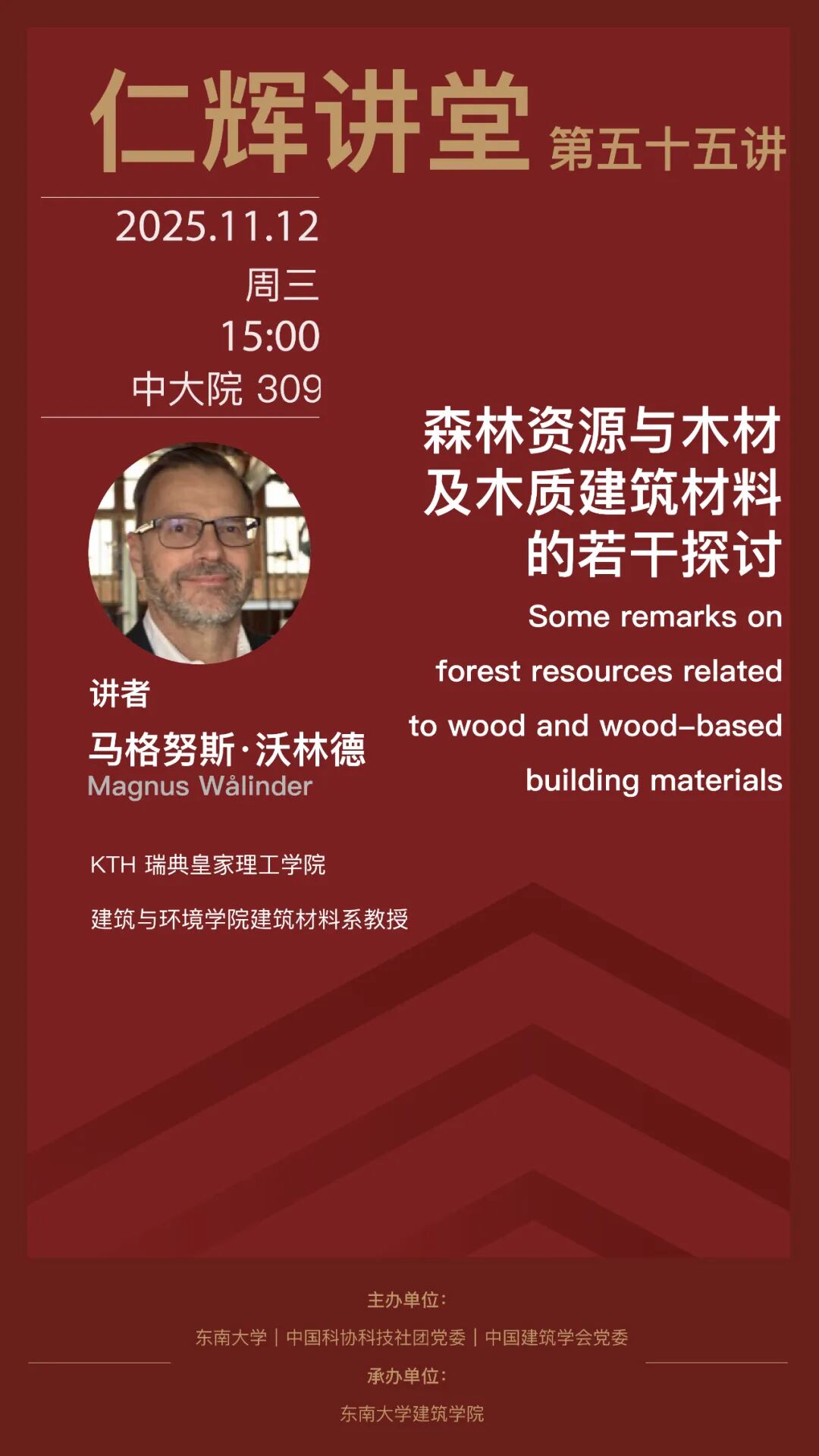
森林资源与木材及木质建筑材料的若干探讨
Some remarks on forest resources related to wood and wood-based building materials
主讲人: 马格努斯•沃林德
Magnus Wålinder
当前经济体系中投入的绝大多数资源(超过900亿吨)均来自地球提取的物质资源。其中包括有限资源(如矿物、矿石以及化石燃料等能源载体),这是占比最大的部分;以及可再生生物质资源(如食物、农作物、纤维及木制品)。据估算,约有60%的这些资源被用于建筑材料及其制造过程。
在本次报告中,将重点阐述提高可再生建筑材料比例的潜力,尤其关注木材及木质建筑材料。报告的第一部分将简要回顾全球森林资源的现状;第二部分将探讨木材作为建筑材料的典型优缺点,并进一步讨论其在结构工程中作为木结构或工程木制品(EWP)的具体应用。
The vast majority of the inputs in the economy, currently over 90 billion tonnes, consist of material resources extracted from the Earth: both finite materials (minerals, ores and energy carriers such as fossil fuels), which by far is the largest proportion, and renewable biomass (food, crops and fiber and wood products). An estimated 60% of these resources are used as building materials including their manufacturing processes. In this presentation I will elaborate on the potential for increasing the proportion of renewable building materials, mainly focusing on wood and wood-based building materials. As a first part, a short review of the world’s forest resources will be discussed. In the second part, typical pros and cons of wood used in general as a building material, and more specific for uses as timber or engineered wood products (EWPs) in structural engineering applications, will be discussed.
讲者简介
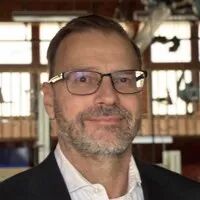
建筑与环境学院建筑材料系教授,自2011年6月起担任该校建筑材料研究组负责人,长期从事木材技术与木质材料研发,具有约20年的科研与实践经验,曾任瑞典SP技术研究院木材科技研发组负责人。其教学内容涵盖建筑材料基础与高级课程、木结构及木基复合材料设计等方向,主要研究领域为可再生生物基建筑材料,尤其聚焦于木材与木复合材料的粘合科学、表面科学、湿润与吸湿特性、气体吸附、木材改性及木-塑复合材料等。Wålinder教授致力于推动“以可再生资源制造未来生物基建筑材料”的理念,强调在建筑领域提升资源利用效率、延长材料使用寿命并实现循环再生利用。同时,他在国际合作与行业网络中具有广泛影响,积极参与多项欧洲工作组和瑞典国家级科研协作项目。
Magnus Wålinder, professor at the Division of Building Materials, School of Architecture and the Built Environment, KTH Royal Institute of Technology. Since June 2011, he has served as the Head of the Building Materials Research Group. With nearly 20 years of research and practical experience in wood technology and wood-based material development, he previously led the Wood Technology R&D Group at the SP Technical Research Institute of Sweden.
His teaching covers both fundamental and advanced courses in building materials, as well as timber and wood-based composite design. His main research focuses on renewable bio-based building materials, particularly wood and wood composites, including adhesion science, surface science, wetting and sorption behavior, gas adsorption, wood modification, and wood–plastic composites.
Professor Wålinder is dedicated to promoting the vision of developing future bio-based building materials from renewable resources, emphasizing improved resource efficiency, extended material service life, and circular utilization within the built environment. He is also actively involved in international collaborations and professional networks, serving as a member of several European working groups and Swedish national research collaborations.
